
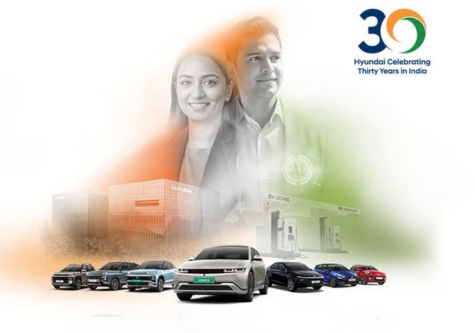
Celebrating 30 years in India, Hyundai Motor India has crossed 13.5 million vehicle sales globally from Indian operations. From the iconic Santro to future-ready EVs and a ₹45,000 crore investment roadmap, here’s how Hyundai shaped India’s automotive journey
30 Years Later, Hyundai Still Feels Young
There are very few automotive brands in India that have managed to become more than just a carmaker. Hyundai is one of them.
For millions of Indian families, Hyundai was the first premium hatchback, the first feature-loaded sedan, the first connected SUV, and for many enthusiasts, even the first turbo-petrol thrill. From the days of the iconic Santro transforming urban mobility to today’s Creta and Verna dominating conversations, Hyundai’s India story has quietly become one of the most important chapters in the country’s automotive evolution.
Now, as Hyundai Motor India Limited (HMIL) celebrates its 30th Foundation Day, the company isn’t just looking back at nostalgia. It is preparing aggressively for the future.
And the numbers behind this journey are massive.
13.5 Million Vehicles Sold: Hyundai’s India Story in Numbers
Hyundai announced that it has sold over 13.5 million vehicles since entering India in 1996. Out of this, more than 9.6 million vehicles were sold in the domestic market, while over 3.9 million units were exported to 150 countries globally.
That export number is particularly significant.
India today is not just a market for Hyundai — it has become one of Hyundai Motor Company’s biggest global manufacturing and export hubs. In fact, Hyundai says it remains India’s largest passenger vehicle exporter on a cumulative basis.
For a brand that started operations nearly three decades ago in Tamil Nadu, that is a remarkable transformation.
A ₹45,000 Crore Future: Hyundai’s Big Bet on India
While most anniversary celebrations focus on the past, Hyundai used this milestone to talk about what comes next.
The company has announced a massive ₹45,000 crore investment plan between FY26 and FY30. The investment will focus on:
- Manufacturing expansion
- Electrification and EV ecosystem
- Future mobility solutions
- Product development
- Localization and supply chain growth
Hyundai also confirmed plans to introduce 26 new products and variants by FY2030, signaling one of the brand’s biggest product offensives yet.
For Indian buyers, this likely means a stronger EV lineup, updated ICE models, hybrids, connected mobility technologies and more localized global products in the coming years.
Chennai to Pune: Hyundai Expands Manufacturing Muscle
Hyundai’s India manufacturing journey began in Sriperumbudur near Chennai back in 1996. Over the years, that plant became one of Hyundai’s most important global production facilities outside Korea.
Now, with the addition of the Talegaon plant in Pune during 2025, Hyundai has significantly strengthened its manufacturing footprint.
Combined annual production capacity now stands at 9.94 lakh units, expected to scale up to 10.74 lakh units by 2028.
This move clearly shows Hyundai’s intention to make India a central manufacturing base not just for domestic demand, but also for global exports.
Hyundai’s Biggest Strength? Its Reach Across India
One reason behind Hyundai’s long-standing success has been its ability to connect with buyers beyond metro cities.
Today, Hyundai operates:
- Over 1,500 sales outlets
- Across 1,100+ cities
- Covering nearly 78% of Indian districts
Its aftersales network is equally massive with:
- 1,675 service touchpoints
- Presence in 1,025 cities
- More than 50,000 trained service professionals
In a country where service experience often defines brand loyalty, Hyundai has consistently stayed ahead by focusing on accessibility and customer trust.
Digital Service, Sustainability and the Modern Hyundai Customer
Interestingly, Hyundai’s biggest transformation over the last decade has perhaps happened behind the scenes.
The company revealed that 91% of repair orders are now opened digitally, while live service streaming and remote diagnostics are becoming standard practices across workshops.
Hyundai has also expanded its extended warranty programs, with over 3.2 million policies sold till date.
On the sustainability front, HMIL says all its offices and manufacturing plants are now powered using 100% renewable energy under the RE100 initiative. The company is also targeting carbon neutrality by 2045.
These are no longer just corporate buzzwords. For global automakers, sustainability and digital customer experience are rapidly becoming core business priorities — and Hyundai appears determined to stay ahead of the curve.
Beyond Cars: Hyundai’s Growing Impact on Communities
Hyundai’s presence in India now extends far beyond the automotive space.
Through the Hyundai Motor India Foundation (HMIF), the company says it has invested over ₹803 crore in CSR initiatives since 2014, impacting around 2.2 million lives annually.
The scale of initiatives is extensive:
- 1.29 million trees planted
- 850 acres of land restored
- Water conservation projects
- Skill development programs
- Scholarships for students and para-athletes
- Healthcare outreach in underserved regions
For a company that once entered India as a foreign automaker, Hyundai today positions itself as a deeply embedded contributor to India’s social and industrial growth story.
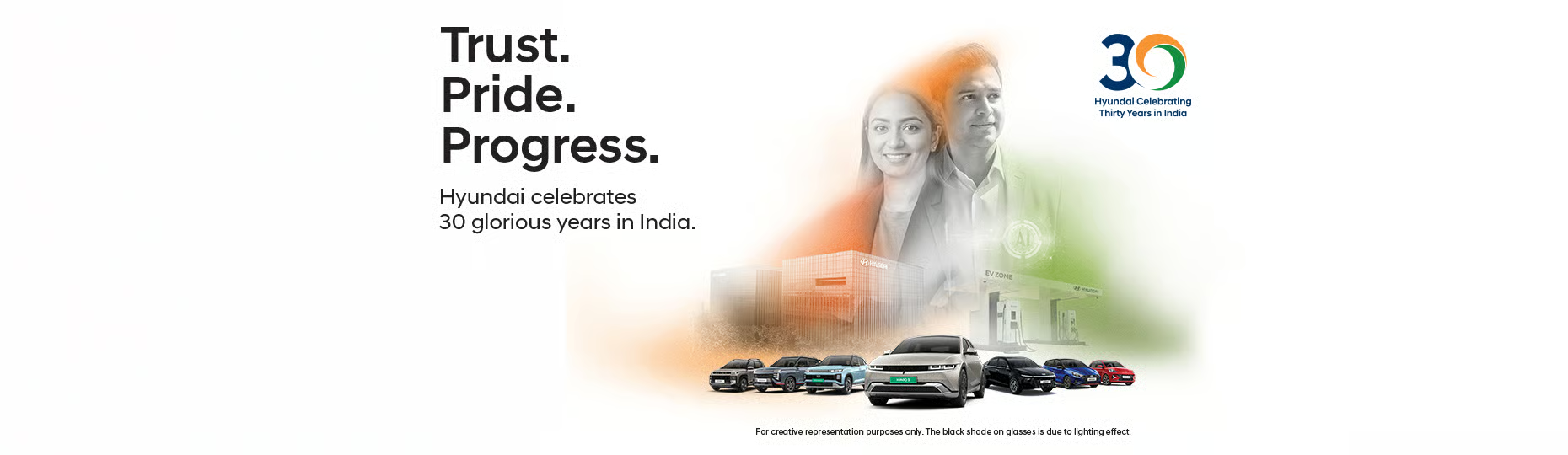
Hyundai’s 30-year journey in India is not just about sales milestones or factory expansion.
It is about understanding how Indian customers evolved — from valuing affordability in the late 90s to demanding technology, design, safety and premium experiences today.
Very few brands have adapted to those changing expectations as consistently as Hyundai.
The next five years, however, may define Hyundai’s biggest challenge yet. India’s automotive market is entering a new era driven by EVs, connected mobility, software-defined vehicles and aggressive competition from both legacy players and emerging brands.
But if Hyundai’s last 30 years are anything to go by, the company knows how to reinvent itself at the right time.
And perhaps that is why, even at 30, Hyundai still feels young.
One thought on “Hyundai Turns 30 in India: From the Santro Era to a Future Built on EVs, Exports and Trust”